
Business Systems That Support Sustainable Growth
Rethinking Growth: From Short-Term Wins to Sustainable Systems
Across global markets, leaders are gradually moving away from the pursuit of short-lived gains toward a more systematic view of growth that balances profitability, resilience, and responsibility. Rather than relying on one-off initiatives, modern organizations are building interconnected business systems that embed sustainability into everyday operations, technology choices, and talent practices. For CreateWork, whose community includes freelancers, remote professionals, startup founders, and established businesses, this shift is not abstract theory but a practical roadmap for building careers and companies that endure.
Sustainable growth, in this context, does not mean slower or less ambitious growth. It describes growth that can be maintained over time without exhausting financial resources, burning out teams, ignoring environmental impact, or losing strategic focus. Institutions such as the World Economic Forum emphasize that companies resilient to shocks tend to invest in long-term capabilities such as digital infrastructure, workforce skills, and climate risk management, rather than focusing only on quarterly results. Readers can explore how global competitiveness is increasingly tied to sustainability through resources from the World Economic Forum and the OECD, which regularly analyzes green and inclusive growth policies.
For individuals and organizations in the CreateWork ecosystem, the question is no longer whether to build for sustainable growth but how to design the systems that make it possible in practice.
The Foundations of Sustainable Business Systems
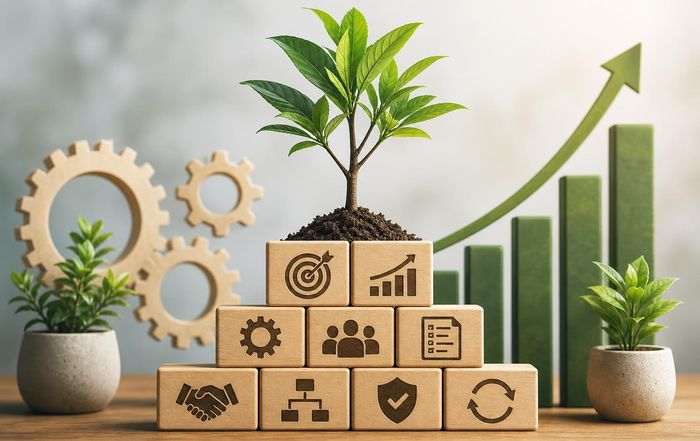
Sustainable growth rests on the interaction of several core systems: financial discipline, operational excellence, technology and data, people and culture, and governance. Research from Harvard Business School and MIT Sloan has shown that companies that align these systems around a clear strategy tend to outperform peers over the long term, especially during periods of volatility. Readers can examine strategic management insights from Harvard Business Review or explore systems thinking approaches in business through resources from MIT Sloan Management Review.
At the financial level, sustainable growth requires predictable cash flows, prudent leverage, and disciplined capital allocation. For entrepreneurs and small business owners, this often begins with building robust budgeting and forecasting practices, monitoring unit economics, and understanding the trade-offs between bootstrapping and external funding. The CreateWork community can deepen its understanding of these fundamentals through internal resources on money and financial resilience and broader financial education via organizations such as the CFA Institute and Investopedia.
Operationally, sustainable systems favor repeatable processes over ad hoc heroics. This might involve standard operating procedures, clear workflows, and consistent documentation, all of which reduce dependency on individual memory and allow teams to scale without losing quality. The International Organization for Standardization (ISO), for example, has developed frameworks such as ISO 9001 for quality management that help organizations formalize and improve processes, while also supporting transparency and continuous improvement.
Remote-First Operations as a Sustainable Growth Lever
Remote and hybrid work arrangements have evolved from emergency responses into long-term operating models, reshaping how organizations design systems for sustainable growth. Studies from Gallup and McKinsey & Company indicate that well-structured hybrid models can enhance productivity, expand access to global talent, and reduce real estate costs, while also supporting work-life balance when managed thoughtfully. Readers can explore research on hybrid productivity from McKinsey and global workplace trends via Gallup's workplace insights.
For CreateWork, remote work is not simply a location choice; it is a structural enabler. A remote-first or hybrid system requires rethinking communication norms, performance management, and collaboration tools. Asynchronous communication, clear documentation, and outcome-based performance metrics become essential to keep distributed teams aligned. Those building remote or global teams can find practical guidance in CreateWork's dedicated resources on remote work strategies and tools, which complement external guidance from organizations like GitLab, one of the most extensively documented all-remote companies, whose remote work playbook has influenced many smaller firms.
Sustainability in remote operations also touches on inclusion and well-being. Research from the Chartered Institute of Personnel and Development (CIPD) and Eurofound shows that while remote work can increase autonomy and reduce commuting emissions, it can also blur boundaries and increase isolation if not managed properly. Organizations that grow sustainably invest in mental health support, clear expectations around availability, and training for managers on leading distributed teams. More insights on healthy remote work practices can be found through CIPD's flexible working resources.
Freelancers and the Flexible Workforce as a Strategic System
The global freelance economy has become a structural component of modern business systems rather than a peripheral or temporary phenomenon. Surveys from Upwork, Fiverr, and the Freelancers Union suggest that a significant share of the workforce in the United States, Europe, and parts of Asia now engages in some form of independent work, ranging from highly specialized consulting to creative services and software development. While methodologies differ, many analysts agree that this trend is long-term, driven by technology, shifting worker preferences, and corporate demand for flexible capacity. Readers can explore labor market perspectives from the International Labour Organization and freelance economy reports from Upwork's research hub.
For businesses seeking sustainable growth, freelancers can be integrated into a broader talent system that balances core employees with flexible contributors. This approach allows organizations to access niche expertise, manage variable workloads, and test new initiatives without committing to fixed overhead too early. For independent professionals, platforms like CreateWork provide a bridge between skills and opportunity, and the site's dedicated section for freelancers and independent careers offers guidance on pricing, contracts, and client management that supports both autonomy and stability.
However, sustainable use of freelance talent also requires ethical and legal clarity. Regulatory bodies in the United States, the European Union, and other regions have updated or are debating rules on worker classification, platform accountability, and social protection for gig workers. Since interpretations and legal frameworks can differ between jurisdictions and sometimes between courts, organizations are encouraged to consult local legal advice and follow updates from regulators such as the U.S. Department of Labor and the European Commission's employment policies. Sustainable systems anticipate these developments, treating freelancers as long-term partners rather than disposable labor.
AI Automation as an Engine of Sustainable Productivity
Artificial intelligence and automation have moved from experimental pilots to mainstream business systems, reshaping how organizations deliver value. Leading institutions such as Stanford University's Human-Centered AI Institute and the OECD document rapid improvements in generative AI, machine learning, and robotics, while also highlighting the need for responsible deployment. Readers can explore global policy perspectives on AI through the OECD AI Observatory and technical progress reports via Stanford's AI Index.
From a sustainable growth perspective, AI is most powerful when it augments human capabilities rather than simply replacing them. For example, small businesses can use AI tools to automate repetitive back-office tasks, support customer service, or analyze marketing data, freeing founders and teams to focus on strategy, creativity, and relationship-building. Freelancers and remote workers can deploy AI assistants to streamline research, content drafting, code review, or translation, enabling them to serve more clients or pursue higher-value projects. To navigate this evolving landscape, the CreateWork community can reference internal guidance on AI automation and future-of-work strategies, which aligns with external best practices from organizations such as the Partnership on AI.
Responsible AI systems also demand attention to transparency, bias mitigation, and data protection. Regulatory frameworks such as the EU AI Act and ongoing guidance from authorities like the European Data Protection Board and the U.S. Federal Trade Commission underscore that AI use must comply with privacy, consumer protection, and anti-discrimination laws. Sustainable growth requires that organizations document data sources, test models for fairness, and implement mechanisms for human oversight, especially in high-stakes decisions related to employment, lending, or healthcare.
Productivity Tools and Digital Infrastructure as a System
Digital productivity tools have become the connective tissue of sustainable business systems, particularly in remote and hybrid environments. Collaboration platforms, project management software, cloud storage, and automation workflows reduce friction, increase transparency, and enable teams to coordinate across time zones. Providers such as Microsoft, Google, Atlassian, and Slack Technologies continue to integrate AI features, security enhancements, and workflow automation into their suites, transforming them into full-fledged operating environments. Users can compare these offerings using independent reviews from sites like G2 and Capterra.
The key to sustainable growth is not adopting every new tool but designing an integrated stack that aligns with business processes and team capabilities. Overly complex tool ecosystems can create confusion, while underinvestment can slow collaboration and decision-making. CreateWork offers curated insights on productivity tools and workflows, helping readers choose solutions that fit their stage, budget, and industry. Complementing these internal resources, organizations can benefit from cybersecurity guidance provided by agencies such as the U.S. Cybersecurity and Infrastructure Security Agency and the UK National Cyber Security Centre, as secure infrastructure is a prerequisite for sustainable digital operations.
Cloud computing, in particular, has become a foundational system for scalable growth. Providers such as Amazon Web Services, Microsoft Azure, and Google Cloud enable businesses of all sizes to access computing power, storage, and advanced services without heavy upfront capital expenditure. Sustainability considerations are increasingly influencing cloud strategies, as major providers publish environmental impact reports and commit to renewable energy and efficiency improvements. Readers can explore cloud sustainability initiatives via AWS sustainability resources and Google's environmental reports.
Building a Sustainable Business from Day One
For entrepreneurs, especially those in the CreateWork audience launching ventures in North America, Europe, Asia, or beyond, sustainable growth begins at the startup stage. Rather than treating sustainability as a later add-on, founders can embed it into their business model, customer value proposition, and operating systems from the outset. This includes clarifying the problem being solved, identifying a viable market, and designing revenue streams that support reinvestment into product development, team growth, and impact initiatives.
A sustainable startup system includes deliberate choices about legal structure, governance, and financing. Some founders opt for traditional corporate forms, while others explore models such as B Corporations, which commit to social and environmental standards verified by B Lab, or cooperative structures where workers or community members hold ownership stakes. Those interested in mission-driven business models can learn more through B Lab's certification resources and social enterprise case studies from Skoll Centre for Social Entrepreneurship.
CreateWork supports this journey with targeted guidance for founders in its section on business startup strategies and planning, while broader business-building frameworks are covered in CreateWork's business insights. External organizations such as the U.S. Small Business Administration (SBA) and Enterprise Nation in the UK provide additional practical resources on business planning, funding options, and compliance, accessible through SBA's learning center and Enterprise Nation's startup hub.
Financial Resilience and Smart Capital Allocation
Financial systems are at the heart of sustainable growth, and they are especially critical for freelancers, small businesses, and remote-first companies that may lack large cash reserves. Sustainable financial management involves building buffers, diversifying income streams, and aligning spending with strategic priorities. For individuals, this might mean maintaining an emergency fund, separating personal and business finances, and planning for taxes and retirement. For organizations, it can involve scenario planning, stress-testing cash flows, and establishing clear investment criteria.
Educational resources from OECD, World Bank, and national financial literacy initiatives emphasize the importance of budgeting, responsible borrowing, and long-term saving. Readers can explore global perspectives on financial inclusion and resilience through the World Bank's financial inclusion work and personal finance guidance from National Endowment for Financial Education. Within the CreateWork ecosystem, the finance and money management section offers targeted advice for independent professionals and small business owners navigating variable income and cross-border work.
For venture-backed or growth-stage companies, sustainable capital allocation also means resisting the temptation to scale prematurely. Analysts and investors increasingly warn against "growth at all costs" strategies that ignore unit economics or burn rates. Instead, they advocate for measured growth that balances customer acquisition with retention, product quality, and operational efficiency. Publications such as TechCrunch and Crunchbase News frequently discuss these dynamics, providing case studies of both disciplined and overextended growth paths.
Upskilling, Talent Systems, and the Future of Employment
Human capital is arguably the most critical system underpinning sustainable growth. As automation and AI reshape tasks, the value of continuous learning and adaptability increases for both organizations and individuals. Reports from the World Economic Forum, UNESCO, and national skills councils consistently highlight the growing demand for digital skills, critical thinking, creativity, and collaboration. These institutions also emphasize that lifelong learning is essential to navigate transitions in employment and business models, especially in knowledge-intensive economies.
For members of the CreateWork community, upskilling is not a one-time event but an ongoing system that blends formal courses, on-the-job learning, peer collaboration, and experimentation. Resources such as Coursera, edX, and LinkedIn Learning offer accessible pathways to develop skills in data analysis, AI, project management, entrepreneurship, and more. Within CreateWork, the upskilling and career development hub provides curated guidance on identifying skill gaps, selecting relevant courses, and integrating learning into busy work schedules.
Sustainable employment systems also require inclusive hiring, fair compensation, and clear progression pathways. Organizations can draw on frameworks from the International Labour Organization and diversity, equity, and inclusion (DEI) best practices promoted by institutions such as Catalyst and SHRM. CreateWork's broader perspective on employment trends and the future of work helps readers understand how global labor markets are evolving and how to position themselves or their organizations for long-term success.
Integrating Sustainability, Technology, and Lifestyle
Sustainable growth is not only about financial and operational systems; it also intersects with lifestyle choices, environmental impact, and community engagement. As remote work, freelancing, and digital entrepreneurship expand across regions such as North America, Europe, Asia, and Africa, individuals increasingly design work around their preferred lifestyles, whether that means living in smaller cities, traveling while working, or balancing caregiving responsibilities with professional pursuits.
Research from OECD and UN-Habitat suggests that flexible work, when supported by adequate infrastructure and policies, can reduce commuting emissions, revitalize smaller communities, and support more balanced urban development. At the same time, it can strain local housing markets and digital infrastructure if not carefully managed. Those interested in broader societal and economic implications can explore reports on urbanization and digital work and green transition in cities.
For CreateWork readers, aligning work systems with personal values and well-being is a defining feature of sustainable growth at the individual level. The platform's insights on lifestyle design and work-life integration complement its coverage of technology trends and economic developments, enabling a holistic view of how professional decisions interact with health, relationships, and community.
A Practical Path Forward for the CreateWork Community
The transition from ad hoc efforts to integrated business systems that support sustainable growth is an ongoing process rather than a one-time project. For freelancers, remote workers, startup founders, and established companies engaging with CreateWork, the path forward involves several reinforcing steps: clarifying long-term goals, adopting remote and flexible work practices that are intentional rather than incidental, integrating AI and automation to augment human capabilities, building robust financial and operational foundations, and investing continuously in skills, culture, and responsible governance.
While global conditions will continue to evolve, the underlying principles of sustainable systems-resilience, adaptability, ethical responsibility, and long-term orientation-remain consistently valuable. By drawing on trusted external resources, from World Economic Forum insights to OECD policy analysis, and combining them with the practical, experience-driven guidance available across CreateWork's main platform, individuals and organizations can design work and business models that not only survive the next wave of change but actively shape a more sustainable, inclusive, and prosperous future.
